

Frontend Editor
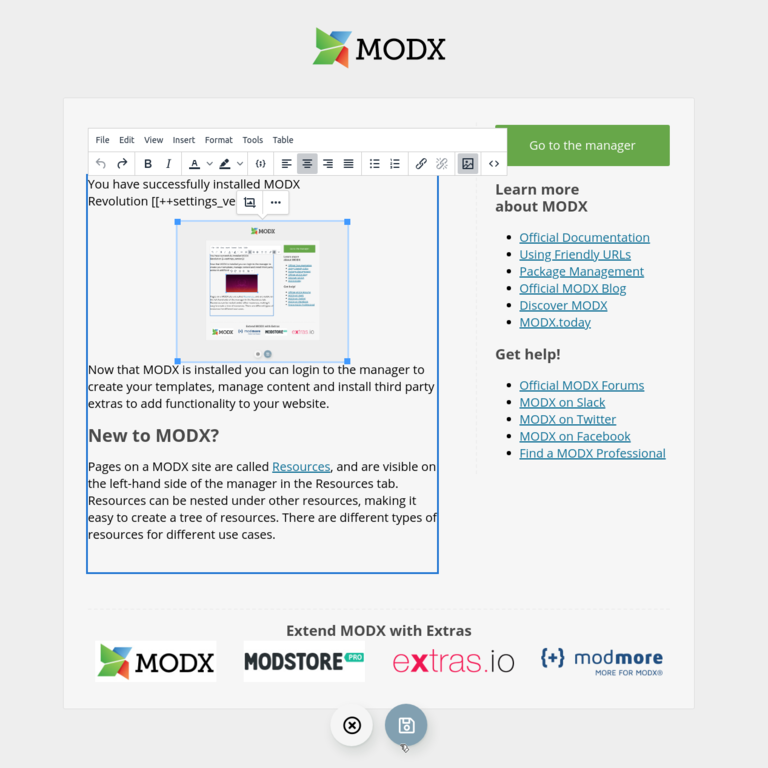
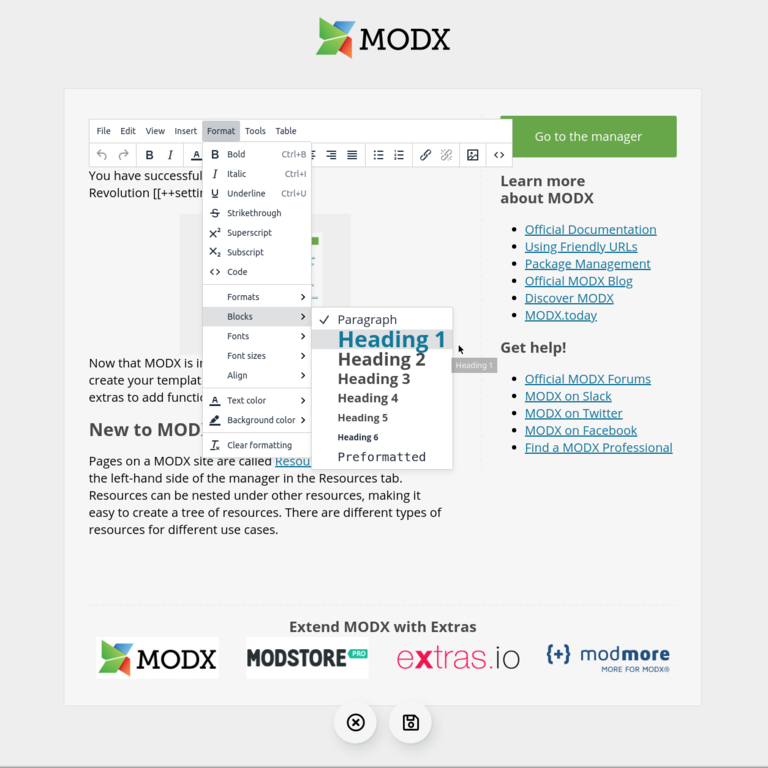
Frontend Editor is a plugin that lets you edit content without opening the Manager. It includes TinyMCE 5 for editing.
Features
- Edit document fields including TV fields.
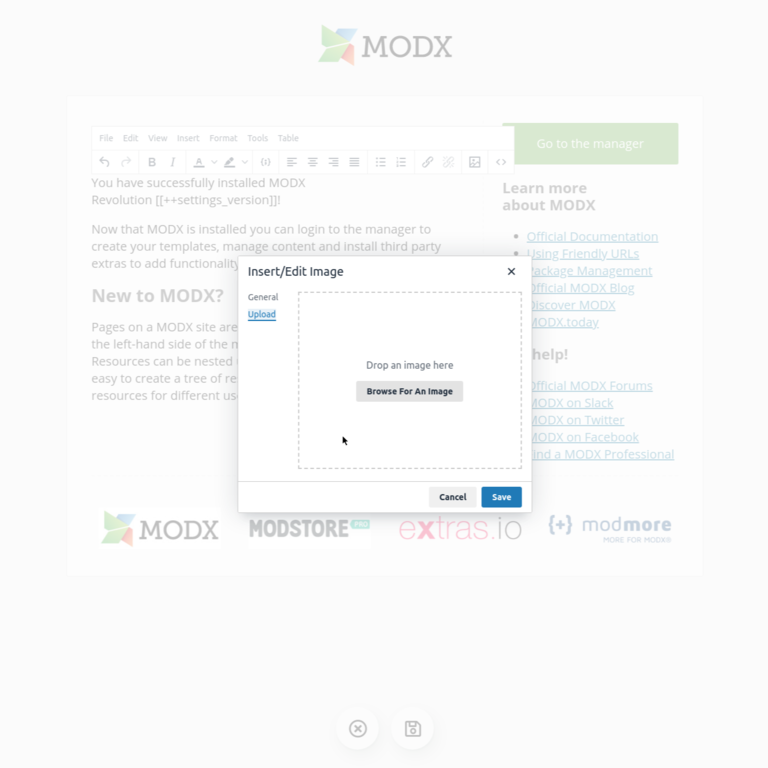
- Simple image upload without the resource manager.
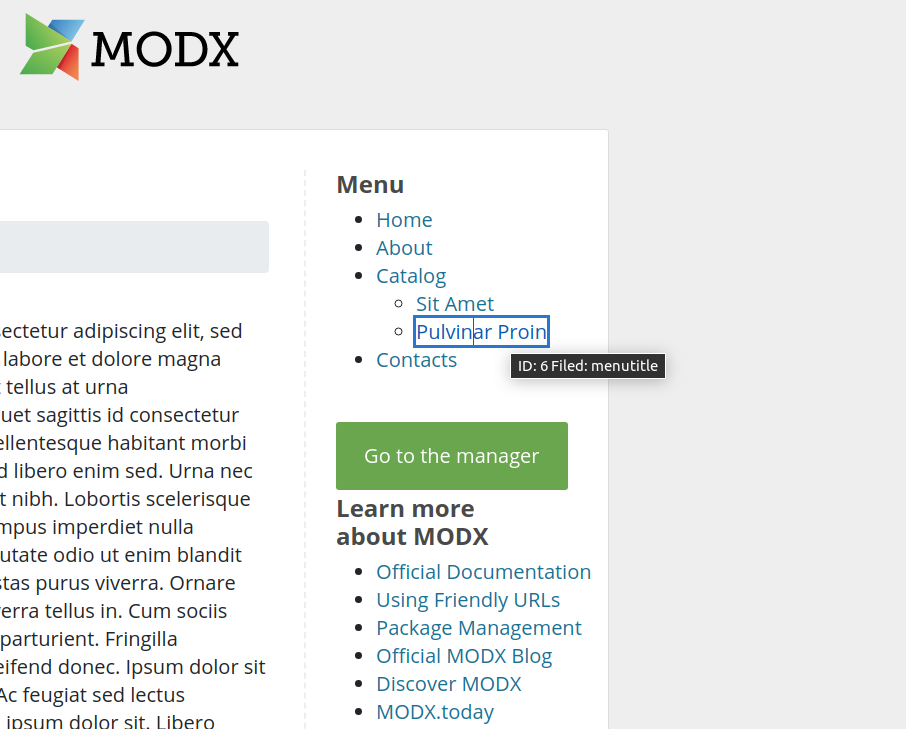
- Edit fields by resource ID (useful for editable menus, breadcrumbs, etc.)
Installation and usage
Install the extra. Wrap fields you want to edit in an element with data-frontendeditor and the field name as the value:
modx
<div data-frontendeditor="content">
  [[*content]]
</div>
Allowed values: content, pagetitle, longtitle, menutitle, description, introtext
Editing TV fields
Use tv- plus the TV name:
modx
<div data-frontendeditor="tv-myTvField">
  [[*myTvField]]
</div>
Editor type
For each field you can use TinyMCE tinymce (default) or a simple input simple:
modx
<div data-frontendeditor="tv-myTvField, simple">
  [[*myTvField]]
</div>
Editing by resource ID
To edit another resource's fields, pass its id as the first option. Useful for editable menus, breadcrumbs, etc.
Example: edit pagetitle for resource id 2:
modx
<a href="/index.php?id=2" data-frontendeditor="2, pagetitle, simple">
  [[pdoField? &id=`2` &field=`pagetitle`]]
</a>
Editable menu example:
modx
[[pdoMenu?
  &parents=`0`
  &tpl=`@INLINE <li><a href="[[+link]]" data-frontendeditor="[[+id]], menutitle, simple">[[+menutitle]]</a>[[+wrapper]]</li>`
]]
menutitle field
For empty menutitle fields, the editor shows pagetitle and saves to menutitle. This can be changed; see extra settings.
Extra settings
- frontendeditor.tinymce_init_default — TinyMCE config; see TinyMCE 5 docs.
- frontendeditor.upload_path — Image upload directory.
- frontendeditor.upload_file_name — File name handling: empty (default), sanitize, or uniqid.
- frontendeditor.menutitle_behavior — For empty menutitle: 0 = normal, 1 (default) = show pagetitle / save to menutitle, 2 = show and save pagetitle.
Requirements
- Pages using the editor must have a DOCTYPE such as
<!DOCTYPE html>. - TinyMCE 5 must support your browser.
Screenshots